
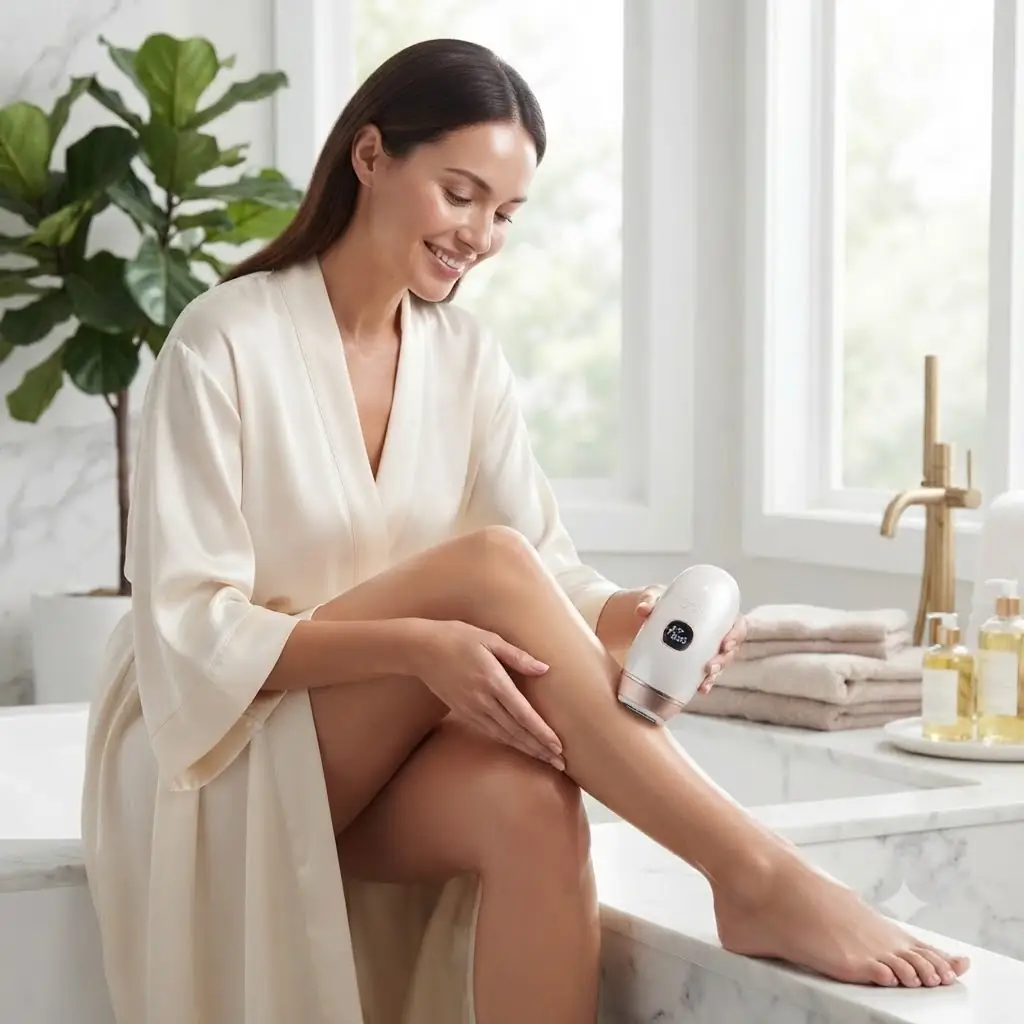
If you have searched whether at-home IPL works, you have probably seen a wall of conflicting forum threads. Here is the honest, direct answer: yes, for the right skin and hair, at-home IPL genuinely reduces hair regrowth, and it is backed by clinical research. But results take consistency and realistic expectations, and it will not work for everyone. The devices are effective on dark hair with light-to-medium skin, they are studied in peer-reviewed literature, and they deliver long-lasting reduction rather than instant permanent removal. Understanding that distinction is the difference between being thrilled with IPL and feeling let down by it.
The short version: At-home IPL works as a hair-reduction tool for suitable users (Fitzpatrick I-IV with dark hair). Expect gradual results over roughly 12 weeks and 8-12 sessions, followed by occasional maintenance. It reduces hair; it does not permanently erase it for everyone.
The honest answer: it works for suitable users
At-home IPL (intense pulsed light) works by sending broad-spectrum light into the skin, where the pigment (melanin) in your hair absorbs it and converts it to heat, disrupting the follicle. Because it relies on the contrast between dark hair and lighter skin, it is genuinely effective for people with Fitzpatrick skin types I-IV and naturally dark hair. If you want the full mechanism, we break it down in how IPL hair removal works.
This is not just marketing. A peer-reviewed study on home-use IPL found the approach to be safe and effective for hair reduction, with no serious adverse events reported among participants. That matters because it means the technology itself is sound when used correctly on suitable candidates. The Cleveland Clinic has also weighed in on the pros and cons of at-home light-based hair removal, and the balanced takeaway is consistent: it can work well, but it is a reduction treatment that demands patience.
So when someone asks "does it work," the honest reframe is: it works if you are a suitable candidate, you use it consistently, and you define "works" as long-lasting reduction rather than a single-session miracle. It is also worth being clear about what home IPL is not. It is a lower-energy, broader-wavelength cousin of professional laser hair removal. That trade-off is exactly what makes it safe to use unsupervised at home, but it also means results build more slowly and typically require more sessions than an in-clinic laser course. None of that makes it ineffective. It simply means the honest question is not "does IPL work" in the abstract, but "will IPL work for my hair, my skin, and my willingness to stick to a routine." For the majority of people with dark hair and lighter skin, the answer to all three is yes.
What "works" actually means: reduction, not removal
This is the single most important expectation to get right. IPL delivers hair reduction, not guaranteed permanent removal. Over a course of sessions, the hair that does grow back comes in finer, sparser and slower. Many people reach a point where their treated areas are so low-maintenance that they shave only occasionally, or barely at all.
But "gone forever" is the wrong mental model. Hair follicles can lie dormant and later reactivate, and hormonal changes can prompt new growth. That is why even people who are delighted with their results keep doing periodic top-ups. Think of IPL as moving you from constant, dense regrowth to a comfortable, low-maintenance baseline that you maintain with a light touch. If a device or seller promises permanent, total removal from a home unit, that is a claim to be sceptical of. Honest brands, including us, talk in terms of long-lasting reduction because that is what the evidence supports.
It also helps to know why removal is not on the table. IPL works by heating and weakening the follicle so it produces less, finer hair or eventually stops for a long stretch. It is not surgically destroying every follicle in a single pass. Some follicles are only partially disrupted and recover over months, and everyone has a small population of follicles that are stubbornly resistant. So the realistic outcome, even for an ideal candidate who does everything right, is a large majority reduction plus a manageable remainder, rather than a perfectly bare, permanently hairless area. Framed that way, IPL is not overpromising: it is one of the most effective things you can do at home to spend far less time managing unwanted hair.
Realistic results timeline
IPL is gradual by design, because hair grows in cycles and only follicles in their active growth phase respond to each session. That is why you need multiple treatments spaced out over time. Here is a realistic, honest timeline for what most suitable users can expect.
| Timeframe | What to expect |
|---|---|
| Weeks 1-2 | No visible reduction yet. Treated hairs may shed over the following days, which can look like slight growth at first. This is normal and not a sign of failure. |
| Weeks 3-4 | Regrowth starts to look patchier and comes in more slowly. Some areas respond faster than others. |
| Weeks 6-8 | Noticeably less hair across treated areas. Many users say this is the point they become confident it is working. |
| Weeks 10-12 (8-12 sessions) | The biggest reduction. Hair is significantly finer, sparser and slower. This is roughly where the initial course completes for most people. |
| After 12 weeks | Maintenance phase. Top-up sessions every few weeks to months keep results steady as any dormant follicles reactivate. |
Timelines vary by body area, hair thickness and how diligently you follow the schedule. Coarser hair on legs or underarms often responds visibly sooner than fine, sparse hair, and areas with denser follicle populations, such as the bikini line, can take a little longer to even out. The pattern, though, is consistent: slow at first, clearly working by the two-month mark, best results by around twelve weeks.
One reason the early weeks feel underwhelming is the hair growth cycle itself. At any given moment only a portion of your follicles are in the active growth phase where IPL can affect them. The rest are resting or shedding and simply will not respond to that particular session, no matter how well you treat. Spacing sessions out over weeks is what lets you gradually catch each follicle while it is active. This is also why a single burst of enthusiastic daily treatment does not speed things up and is not recommended. Patience is not a nice-to-have with IPL, it is baked into the biology, and the people who understand this from day one are far less likely to give up during the quiet opening fortnight.
Why some people say IPL "didn't work"
The forum scepticism is not baseless, and it deserves a fair hearing. In most cases, though, the disappointment traces back to a fixable cause rather than the technology being useless. Here are the common ones, each turned into a lesson.
1. Wrong skin or hair colour
This is the big one. IPL needs pigment in the hair to work, so it cannot target blonde, red, grey or white hair. And it is neither safe nor effective on very dark skin (Fitzpatrick V-VI), because the light gets absorbed by skin melanin instead. If IPL "did nothing" for someone in these groups, it was never going to. Lesson: check your suitability honestly before you buy, using our skin tone suitability guide.
2. Inconsistent use or quitting early
Because IPL only catches follicles in their active phase, skipping sessions or stopping at week four means many follicles never get treated. People who quit before the full cycle often conclude it failed when they simply did not finish. Lesson: commit to the whole initial course before you judge results.
3. Energy level too low
Out of caution, some users keep the device on its lowest setting the entire time. Lower energy is gentler but less effective. Lesson: after patch-testing, work up to the highest level you can comfortably tolerate for your skin.
4. Expecting permanence
Someone expecting hair to vanish forever after a few sessions will feel let down even by a good outcome. Lesson: measure success as reduction and low maintenance, not zero regrowth.
5. Not shaving beforehand
IPL should be used on shaved skin so the energy targets the follicle below the surface, not the hair above it. Leaving hair long wastes energy and can cause surface heating. Lesson: shave the area shortly before each session, and never wax or pluck between sessions since the root needs to be present.
How to get the best results
Getting IPL to actually deliver is mostly about discipline and setup. Here is the checklist that separates the people who love their results from the people who post disappointed reviews.
- Follow the schedule. Treat on the recommended cadence, usually every one to two weeks in the initial phase. Put it in your calendar so you do not drift.
- Shave first. Clean, freshly shaved skin lets the light reach the follicle. Do not wax or epilate between sessions.
- Use the highest comfortable energy level. Patch test, then step up. Higher intensity within your comfort range means better follicle disruption.
- Treat consistently and cover the whole area. Overlap your passes slightly so you do not leave untreated gaps.
- Be patient through the full cycle. Judge results at weeks 8-12, not week two.
- Do maintenance. Once you hit your reduction goal, keep occasional top-ups to hold it.
On the hardware side, this is where a well-designed device helps you stay consistent. FlashSmooth Core has adjustable energy levels so you can start gentle and safely work up to the strongest comfortable setting, plus built-in ice-cooling on the treatment window to make higher intensities more tolerable on sensitive areas. That is not a magic upgrade over the biology of IPL, it simply removes two of the real-world reasons people back off intensity or skip sessions. Before you start, it is worth reading whether at-home IPL is safe so you use it correctly from day one.
Who gets the best results, and who won't
The best candidates are people with dark brown or black hair and skin in the Fitzpatrick I-IV range. On this combination, the contrast between hair and skin is ideal, and results tend to be the most dramatic. If that sounds like you, our suitability guide confirms exactly where you sit and how to set up your device.
IPL is the wrong tool if your hair is blonde, red, grey or white, because there is not enough pigment to target. It is also not appropriate for very dark skin (Fitzpatrick V-VI), where professional options with the right technology are safer and more effective. If either of those applies to you, do not force it. Buying a home IPL device in those cases is the fastest route to a disappointed review, and no amount of technique will change the outcome. Compare your realistic options in our guide to IPL versus laser hair removal, since certain professional lasers are designed to work on skin and hair combinations that home IPL cannot safely treat.
There are also a few situations where IPL is not about hair or skin colour at all. Pregnancy, certain photosensitising medications, recent sun exposure or tanning, tattoos or dark moles in the treatment area, and some skin conditions are all reasons to hold off or check with a professional first. Being honest with yourself about these upfront saves you from a frustrating experience later, and it is exactly why we cover safety in detail rather than glossing over it.
The bottom line
Does at-home IPL work? For suitable users, honestly yes. It is clinically studied, it meaningfully reduces regrowth, and it lets you reach a low-maintenance baseline you maintain with occasional top-ups. It is not a permanent-removal miracle, it does not work on unsuitable hair or skin, and it rewards consistency over the full twelve-week cycle. The people who are happiest with IPL are the ones who checked their suitability, followed the schedule, used a comfortable-but-effective energy level, and gave it time. If that is you, the results are real, and they last.
Ready to start? FlashSmooth Core is built for exactly this routine, with adjustable levels, ice-cooling and a 90-day money-back guarantee so you can see how your own skin and hair respond, risk-free.